I’ve got the greatest job in the world. Not just because I’m a writer and can sit around the house all day eating bonbons and listening to counter-retro jazz fusion while everybody else is slaving away for cruel taskmasters. No. Because I spend all my working hours with the most fascinating people who never lived.
The kind of people who populate my thrillers, Westerns and love stories and do fabulous and exciting things, often in exotic places or in an even more exotic past century. The kind of people who make parties fun and brawls unspeakable. The folks you’re happy to join for a beer but don’t want moving into the house next door. Because some of the things they do – well, a lot of the things they do – are anti-social or howling nuts.
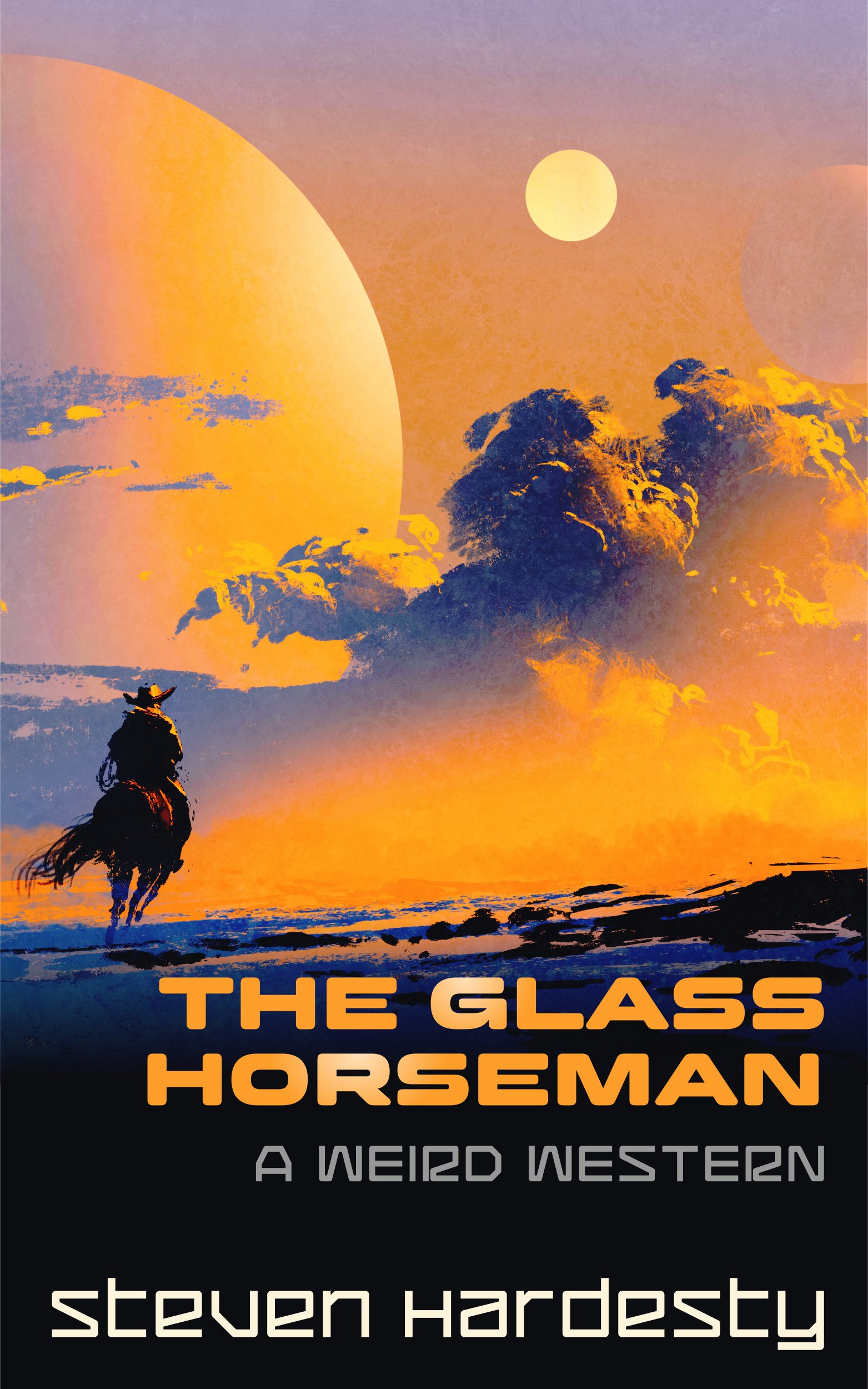
Let me give a for-instance. I just finished the first draft of my first weird Western – The Glass Horseman – and, as usual after a novel’s finish, I’m feeling blue. I had such fun for so long with the people who live in the story – a young cowboy lost in the wrong world, charming outlaws and grumpy lawmen, a very strange lady coffin-maker and her stranger waterboy, all harried by targeted tornadoes, invisible walls and a gunfight at the O.K. Corral over and over again – that now, the draft finished and them gone away, I miss ‘em.
Well, some I don’t miss – the villains. They were especially villainous. In fact, the main evildoer invaded The Glass Horseman from my historical Western novel The Gunfighter. And I wished he’d stayed there. Ah, well, so did the hero, Leander Phipps, who is an even callower version of the hero in that series.
All the villains – Ike Clanton, Wyatt Earp, Doc Holliday and the Gleason brothers gang – proved so aggressively awful and committed such savage crimes that I took a lot of pleasure in letting my young hero finally do unto them as they deserved to be done unto. Or sort of.
That’s another joy of the writing life – you can take revenge on every character who deserves it and get away with it. Shoot this one with a six-gun, stab that one with a salad fork, shove another off the boat into the Arctic Ocean with the snapping polar bears. No worries about cops knocking on your door. Or friends of villains potshooting you in a parking lot.
On the other hand, when you stumble across a hero or heroine, like Young Phipps, standing battered but determined in the face of misery and outrage, you can feel that you too are standing there alongside, ready to fight for the right and the decent. Ready to help civilize the Wild West or bring down the mafia or comfort the lost and forlorn victims of war.
It’s a great feeling when you see those things happening on the page you’re writing. You forget you’re a bum sitting on your bum in front of a computer screen tossing back bonbons. You remember the whole point of a writer’s life – to say as best you can what you have to say about being a decent human being in a world where decency too often is in short supply.
We live in a real world of sprawling tyrants, sneering bullies and gutless liars no different than the villains in my fiction. But ours also is a world of decent folk who deserve a break in life and sometimes, but only sometimes, get it.
So it’s as much a surprise to me as I bet it is for my readers when the good guy wins in my novels. Because I never know what’s going to happen in a story until I write it. I don’t write to outline, you see, I write by the seat of my pants. Flying blind through the story pretty much the way you read it, not knowing what’s going to turn up on the next page. I do that because, if I plot a story in advance then I’ve told the story and it’s dead to me and I can’t write it.
Usually, I get within 30 or 40 pages of “The End” before I can see where a novel is going and how the hero is going to squeeze out of his or her fix. Sometimes I can’t see clearly how it will wrap up and I write many pages past The End and must go back and cut text to reach the true end point.
With Glass Horseman, however, I had no idea how the novel would end until an hour or two before it happened. Then – bingo! – those two magic words popped up. Ending all my jittery worries that this story might go on forever and never find its End.
But I was shocked to see how many engaging characters had to be sacrificed to the weirdness all around them, and to the villains, to reach a powerful endpoint. I hated to see them go. I’d hoped that one or two could become the hero/heroine of their own spin-off novels. But that didn’t happen. And all I could do was watch, stunned and wondering, as other things happened to all these people.
I suppose it would be cliché to say that the process of writing, like the process of living, is a mystery too full of “Whys?” and too empty of Answers.
So, too, writing, like life, is too full of villains and too short on heroes. And it feels great when a story like Glass Horseman wraps itself up as it did, with a hero who has come to know himself. (Sort of.) Making him a hero worth your knowing (I hope), not just to share a beer in the tavern down the road but to welcome into the neighborhood. (Or maybe not.)
That’s why, this weird manuscript done, I miss ‘em all.
PS: The Glass Horseman should be ready for publication and available on Amazon shortly.
© 2023 Steven Hardesty